
Small Investors and Substack Financial Advice
Should small investors follow investment advice from Finance Substack?

Finance Substack has become a meaningful paid-content business. Many accounts now sell investment-related material, from market commentary to stock picks, from deep dives into individual companies to model portfolios and systematic strategies. High-profile market research on Substack can move markets, with top accounts charging from $50 to $100 per month, while smaller accounts aimed more clearly at retail investors often charge from $5 to $25.1
In this post, I take a look at what this means for small investors. I focus on practical questions such as accountability, suitability, implementation, and cost. I should preface that many2 of the accounts that sell this content mean well and are run by competent people who have a solid understanding of their craft. These people have invested their time and resources to develop their investment approaches and have used them to compound their wealth, and want to help others do the same (for a fee). But this doesn’t automatically mean that following their strategies is the right approach for a given individual investor.
Regulated or Not?
The SEC definition of an investment adviser is as follows:3
[…] any person or firm that:
for compensation;
is engaged in the business of;
providing advice to others or issuing reports or analyses regarding securities.
The person in question must satisfy all three elements to be considered an investment adviser. The third element is where many finance Substacks enter the grey zone, as “advising others about securities” encompasses things like:
advice about market trends;
providing a selective list of securities;
advice about asset allocation.
In sum, writers selling access to security recommendations, model portfolios, buy/sell alerts, private communities, or “copy my portfolio” content while relying on generic “not investment advice” disclaimers could, in principle, fall within the scope of the definition.
However, there are important exceptions under U.S. securities law. The most relevant in this context is the publisher’s exclusion, which applies to newspapers, magazines and financial publications. To qualify, the publication must be general and impersonal, bona fide/disinterested rather than promotional, and not timed to specific market activity. As an example, a federal U.S. court dismissed a proposed class action accusing Seeking Alpha of acting as an unregistered investment adviser, ruling that the publisher’s exclusion applied to Seeking Alpha.
Recent cases like the Citrini post that seems to have significantly moved markets have sparked a debate about regulation of financial research for profit on Substack. Mark Rubinstein wrote in the FT at the time:
Markets have always found their way around the structures regulators build, and research is no different. Citrini is just the most dramatic expression of where that migration ends up: market-moving distribution with zero disclosure architecture. Nobody reads the disclaimers anyway. In a world where everything is entertainment, who wants to be slowed down by six pages of small print?
In the FT article, Rubinstein reports that the UK’s Financial Conduct Authority (FCA), the main conduct regulator for UK financial services, took criminal action against finfluencers (a truly hideous word) who “tout products or services illegally and without authorisation through online videos and posts, where they use the pretence of a lavish lifestyle, often falsely, to promote success.” This suggests that regulators are willing to draw a line, but the most obvious targets are closer to unscrupulous finfluencers than to bona fide publications.
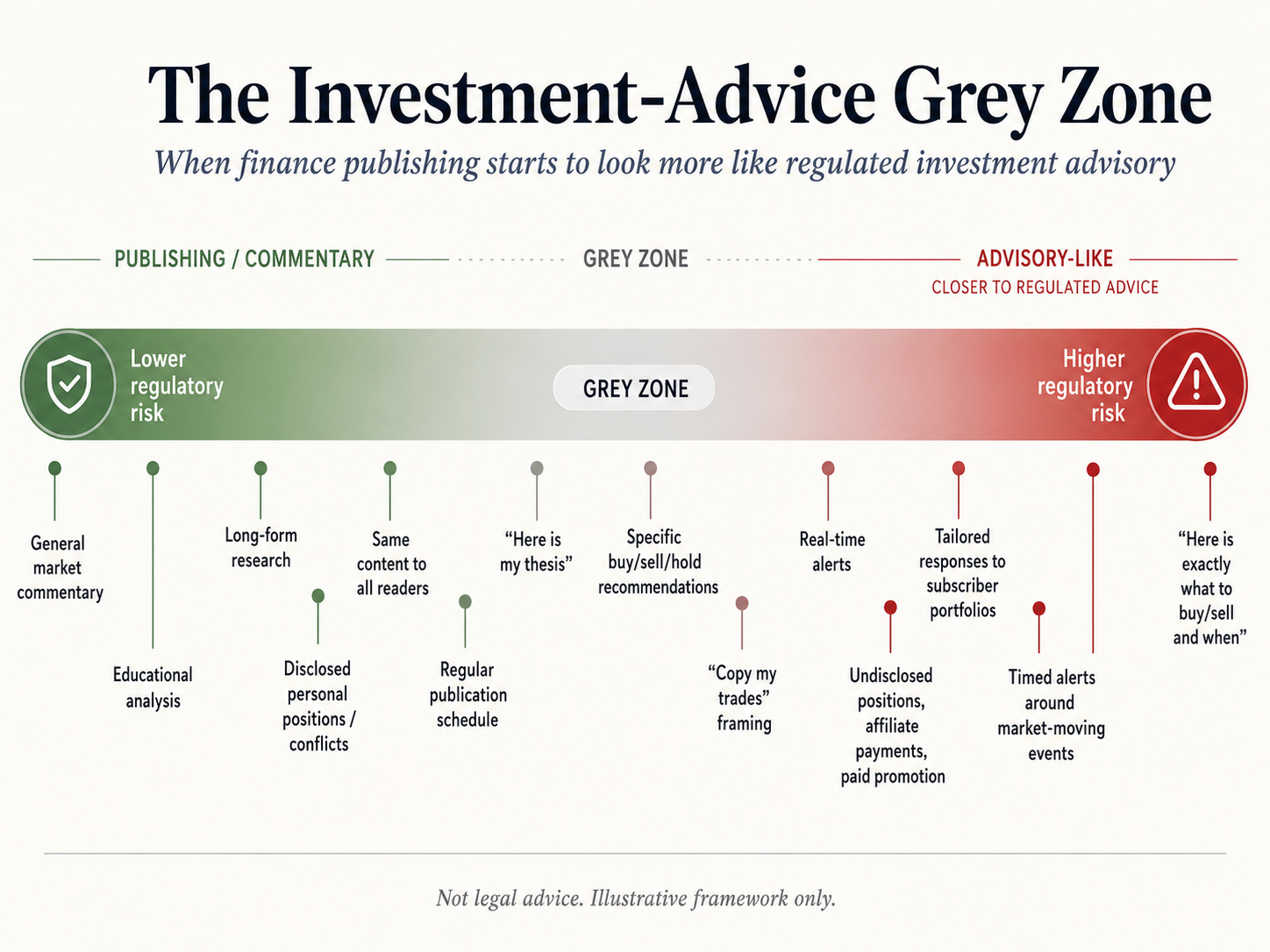
Overall, as long as the content is not tailored to individual readers, Substack content appears to fall within the publisher’s exclusion. For fun, I asked AI to generate a visual depicting where a financial publication would fall in this regulatory spectrum. Funnily enough, AI hedged its own risk with a legal disclaimer.
The main tension is that there is money to be made in Finance Substack. There are basically no entry barriers, and success can depend as much on marketing as on the quality of the content. This post gives a nice overview of the business model and the different types of Finance Substack publication.
Some readers may be reading this and asking “so what?”, which is a very valid question. Who cares if a Substack account falls under some regulatory agency’s definition of adviser? What matters is the value they derive from their paid subscription. That may well be the case for many subscribers, especially buy-side and professional money managers who subscribe to the more expensive research accounts, or individual investors who are financially savvy and know what they’re getting into. But that is not the case for every reader or subscriber. The main issues are accountability and disclosure. Many accounts are fully anonymous, so you may be getting financial advice from an experienced professional in the industry, or simply an anonymous promoter quietly talking his own book. On the other hand, it could be argued that no one really expects from these accounts the same kind of systematic disclosure, fiduciary, supervisory, and recordkeeping obligations that apply to registered advisers and broker-dealers.
Suitability
Broadly speaking, suitability means that a recommended securities transaction or investment strategy is suitable for the customer, based on information obtained through reasonable due diligence to understand the customer’s investment profile. That is, investment advice doesn’t exist in a vacuum. In regulated investment advice, this is central to investor-protection regulation, because advisers are supposed to act in line with the best interests of their clients, offering them investment products or strategies that are suitable for them.
Unless they are operating as registered advisers or otherwise subject to a fiduciary standard, Substack publishers generally do not owe subscribers the kind of fiduciary duty associated with regulated investment advice. The information provided is not usually tailored to any one individual investor. In fact, doing so would arguably move them much closer to the regulatory definition of an investment adviser.
The suitability question doesn’t imply anything negative about a Substack account or content. An investment strategy or trade recommendation can be intelligent, well researched, and profitable for the author, yet still be unsuitable for many subscribers. Investors relying on Substack financial content therefore need to do their own research to understand who they’re following and why. If they’re paying someone for research or model portfolios/signals, the main question becomes whether the advice being sold makes sense for their own situation.
A leveraged trend-following strategy, a concentrated small-cap portfolio, or a monthly tactical ETF model may be sensible for one investor and inappropriate for another. Suitability depends on time horizon, liquidity needs, tax situation, risk tolerance, existing holdings, experience, and the investor’s ability to execute the strategy consistently. A Substack writer usually does not know any of these things about the subscriber.
In the marketplace of Finance Substack, as elsewhere, investors need to apply a healthy dose of caveat emptor.
Strategies & Implementation
Once paid content moves from general research to tradeable signals or model portfolios, the investor faces a second problem: implementation. That is, the subscriber must size positions, trade consistently, manage taxes, and avoid discretionary overrides. There are many different kinds of investment strategies being sold on Substack. I summarize some of the main possibilities below.
General research: many paid accounts provide general macroeconomic or market insights that are not necessarily actionable. It’s up to subscribers how they use that information.
Stock picks: accounts that provide recommendations for individual stocks to buy or sell. Subscribers decide what to act on, how to size positions and execute any trades.
Market timing/signals: strategies that give sporadic signal to go long or short a given instrument. For instance, a “buy the dip” model could trigger a signal sporadically, which is sent to subscribers, who then would have to execute trades manually.
Model portfolios: This is probably one of the most common kinds of advice-like paid finance content available on Substack. A typical case is a tactical asset allocation model implemented using ETFs. The publisher provides a target portfolio at a given rebalancing frequency (typically monthly). Some accounts provide example scripts to automate execution, which a DIY-minded systematic investors could adapt and use.
I’m a big proponent of following a DIY systematic investment approach, which is what I personally do. This does not necessarily mean a complicated quantitative trading system, and does not necessarily require automation. In my view, it’s better to follow a simple asset allocation that you understand well and can execute consistently, than following some complicated system or trading strategy that you know superficially, or that has some hidden tail risk you’re not aware of.
Many tactical asset allocation strategies have decent performance, are easy to implement/execute with ETFs, and are suitable for relatively small accounts. It has never been easier to backtest these strategies, or even to create your own app to automate parts of the investment workflow, from signal generation to execution. I documented my own version of this in a previous series of posts, mostly as an experiment with agentic AI, and it eventually became part of my own investment process. There are many details and pitfalls, but this can be a rewarding journey on its own, with the added benefit that you don’t need to rely on anyone else to provide you with allocations or signals.4 A good starting point is to read a good book on the topic, such as Robert Carver’s Systematic Trading.
Many of the tactical allocation strategies that I see on Substack and elsewhere are variations of a few common themes, such as long-only trend following using simple filters (see for example Faber, 2007) and dual momentum strategies (see Antonacci, 2017). They are not difficult to implement and adapt independently. Many websites also track these kinds of strategies, allowing investors to compare their performance, level of risk etc.
Assuming that an investor has selected a given investment approach, following it consistently is extremely important. Suppose you spend a lot of time studying how to invest your money. You carefully select the right investment approach that is suitable for your preferences. But then, you do not execute the strategy diligently. Sometimes you forget to rebalance the portfolio, or rebalance differently from your backtest. Other times, you manually change allocations based on gut feeling or a recent post you’ve read. In this case, you have done only half the work, and your realized performance can no longer be compared cleanly with the strategy’s backtest or published track record. It would have been better to just follow a passive strategy.
Although many valid investment approaches can be found on Finance Substack and elsewhere, in my opinion small investors should be particularly careful with the following:
Day trading of any kind: it is well documented that most day traders lose money, see for example Barber, Lee, Liu, and Odean (2009, 2014); Chague, De-Losso, and Giovannetti (2020).
Using single-stock trading as a core strategy: successful stock picking is exceedingly difficult. Bessembinder (2018) shows that most individual U.S. stocks underperform one-month Treasury bills over their full sample lifetimes, and that the aggregate wealth creation of the U.S. stock market is concentrated in a very small fraction of firms. For small investors, investing in individual stocks is even more challenging, as the portfolio may not have enough stocks to achieve a decent level of diversification. As the graph below illustrates, adding stocks rapidly reduces idiosyncratic volatility at first, but the benefits flatten out after about 20 stocks. This is not a magic number: a 20-stock portfolio can still be highly concentrated by sector, factor exposure, or position size.
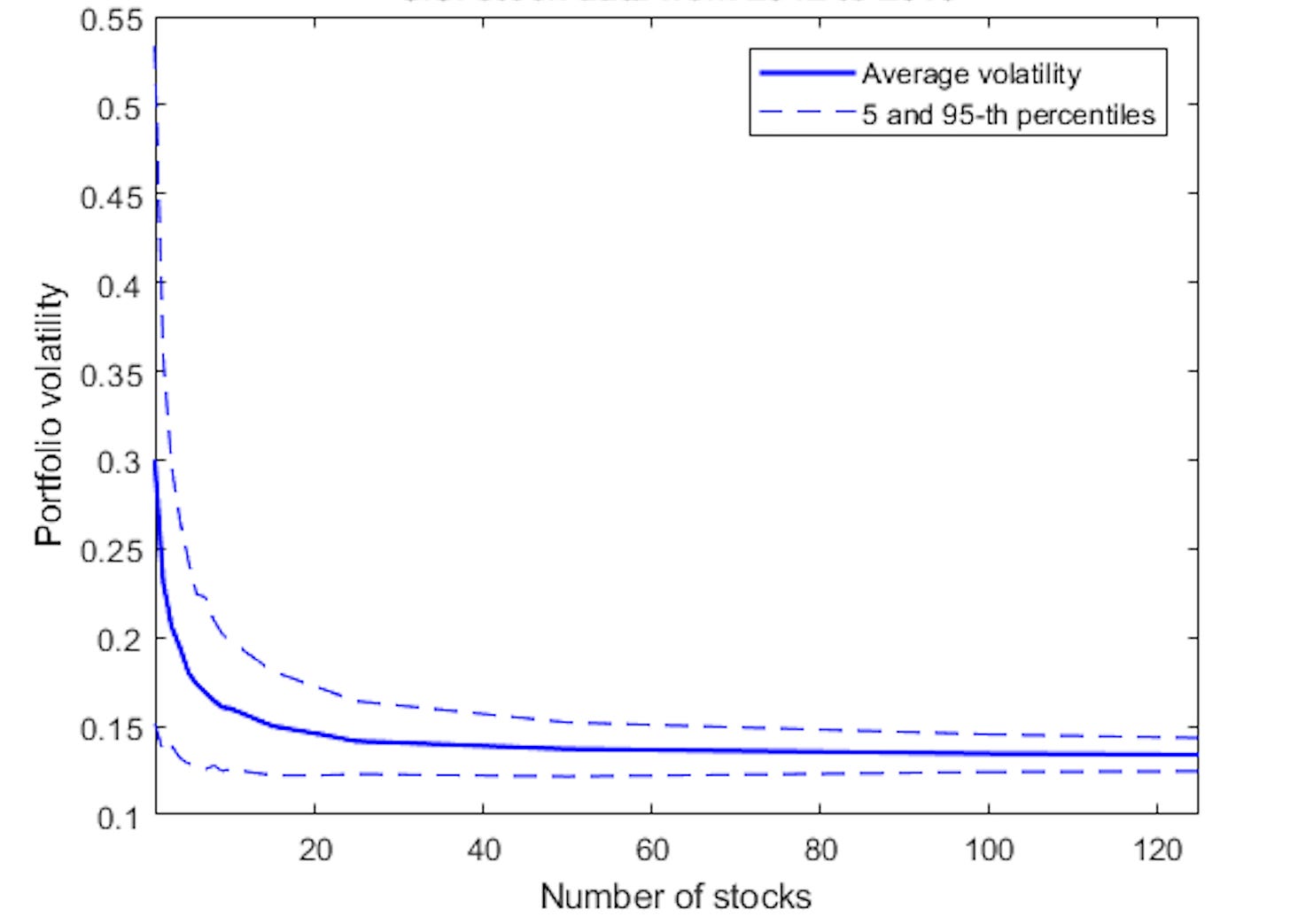
Average annual volatility of equally-weighted portfolios with randomly selected U.S. stocks. It is not impossible to pick stocks successfully, but for small investors this should at most complement a core strategy with diversified exposure.
Trend following using futures: although there’s a lot of evidence for the performance of trend following, the benefits of this type of strategy really materialize when the number of different contracts is relatively large. A minimum account size for doing this properly is of the order of several hundred thousand dollars. It also requires some sophistication in terms of position sizing, signal generation, and execution.
Costs & Benefits
The median size for an investment portfolio is not very large. The median value of holdings in the U.S. was about $53k in 2022. Comparable European figures are harder to define, but euro-area medians for direct risky financial assets are smaller: around €10k for listed shares and €18k for mutual funds among households that hold those assets. This means that costs of any kind can be a significant drag on performance for small investors. Suppose that an investor pays a monthly subscription to a Substack account to have access to a specific investment strategy. Table 1 shows the annualized subscription fee, as a percentage of capital, for different monthly fees and account sizes. The fee can be substantial for smaller accounts. For example, an investor with a €20k investment account, paying a monthly subscription of €20, is effectively paying a 1.2% annual fee, which is very expensive. On top of this, we should add transaction costs (slippage and broker fees), which can erode performance further. And that’s before taxes.
By adding some cost and turnover assumptions, we can estimate the total cost to the investor. Table 2 shows the total annual cost of running a strategy with a monthly subscription fee of €25, using transaction-cost assumptions that vary with account size, for different levels of monthly turnover. Even for a €50k account, the total annual cost can be substantial, up to 1% annually for higher levels of turnover.
We can also estimate the impact on risk-adjusted returns. For simplicity, let’s assume a strategy with a Sharpe ratio of 1 before costs.5 I assume that costs reduce expected returns one-for-one and leave volatility unchanged. Table 3 shows the Sharpe ratio net of subscription fee and estimated transaction costs for various account sizes and levels of turnover. The impact is minor for a €100k account, but can be substantial for smaller accounts with higher turnover. I would argue that accounts below €25k are probably better off following a simple passive allocation.
The Verdict
Substack is a phenomenal place to learn about almost anything. Finance Substack is no different, and many accounts provide access to high quality content that helps readers invest better. Many paid accounts sell actionable investment-related content, including trading signals and target allocations for model portfolios. In this post, I looked at whether it makes sense for small investors to follow such advice. I analyzed the issue from four different perspectives: regulatory, suitability, implementation, and costs/benefits.
My verdict is: for most small investors, paid Substack signals and model portfolios should mostly be treated as education or research, not as something to follow mechanically. Specifically, for smaller accounts, the hurdle implied by the subscription fee can be significant. Below roughly €25k, subscription fees may represent a large cost drag, and a simple, diversified, low-cost allocation would probably be a better default. This doesn’t mean that paid research cannot be valuable, but the smaller the account, the more the investor should be mindful of any costs, including subscriptions, fees or transaction costs from strategies that require frequent trading.
For larger accounts, the fees are not that relevant as a proportion of capital, but investors still need to carefully examine the investment strategy or approach being offered to understand what they’re getting into, the risks involved, and to assess whether a strategy is appropriate for their own situation. Implementation and consistency are also key to allow proper comparisons with backtested or published performance.
DIY investment can be a fun and rewarding journey. There is nothing wrong with outsourcing part of it, but it’s important to have a balanced view of the costs, risks, and benefits.
My own Substack does not sell signals. The paid feature allows readers who see value in what I publish to support the work.
I would like to believe this is most of them, but it is certainly not all of them.
I am not a lawyer.
Investing is a long-term, or even lifelong, endeavor. It’s anyone’s guess whether a given Substack account will be around in 5 or 10 years to provide you with your target allocations.
These numbers are based on expected return of 13%, a volatility of 10%, and a risk-free rate of 3%. This is not far from well-performing tactical asset allocation models.